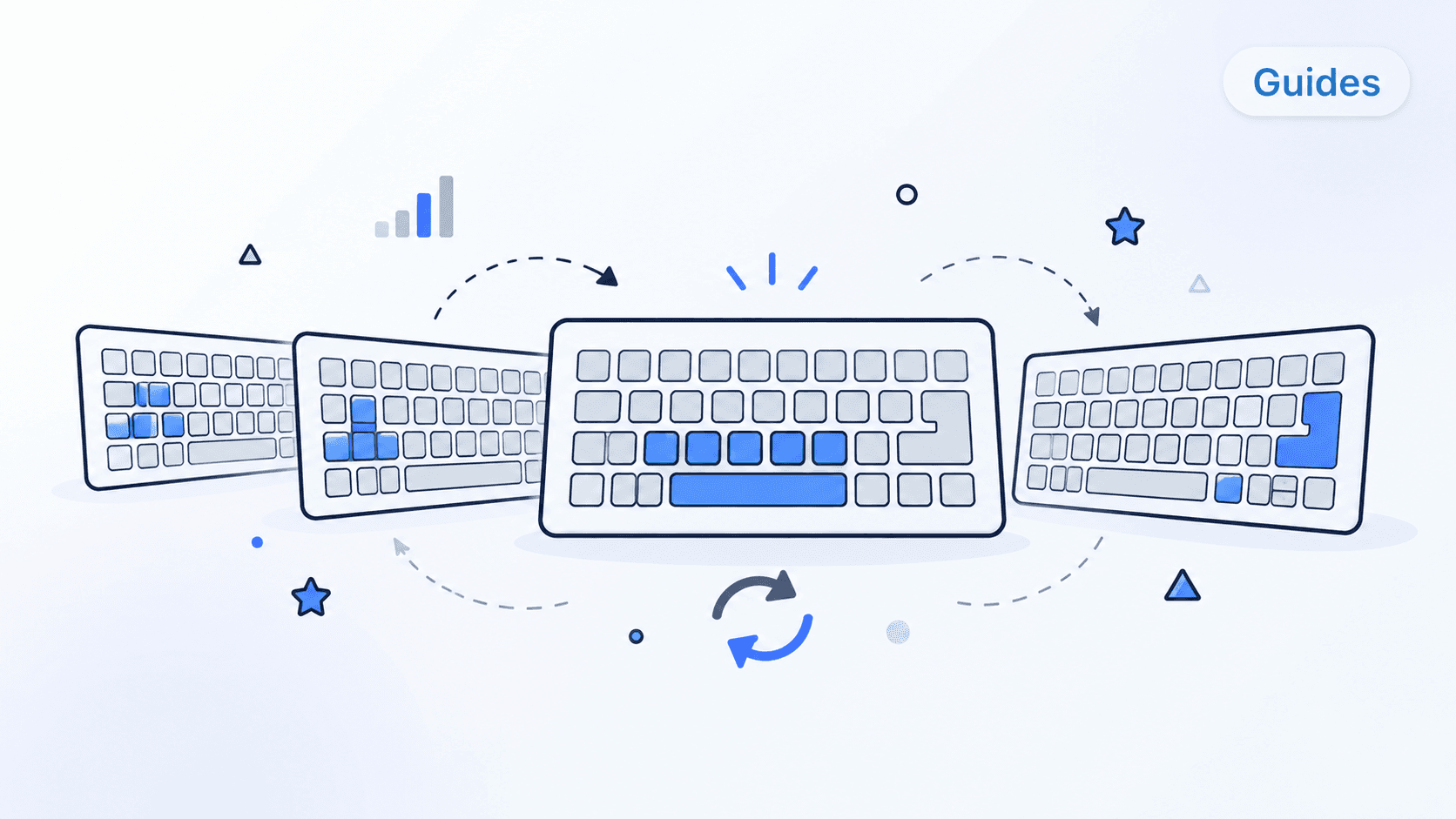
What if the keyboard layout you've used your entire life is making your fingers work almost twice as hard as they need to?
Most of us never question QWERTY. It's on our laptops, mechanical keyboards, and nearly every computer we've ever used. We learn where the keys are, develop muscle memory, and eventually stop thinking about the arrangement entirely.
But QWERTY isn't the only option. Alternative keyboard layouts like Dvorak, Colemak, Colemak-DH, and Workman attempt to make typing more efficient by changing where letters sit beneath your fingers.
The question is: how much difference does a keyboard layout actually make?
We built an interactive experiment at The Typing Cat to find out. Our Keyboard Layout Comparison Lab lets you compare up to 16 layouts simultaneously, watch animated hands type the same passage, and measure how far individual fingers and wrists travel.
And the results are surprisingly dramatic.
The short answer
On the same 5,847-character English passage, every popular alternative layout needed roughly 42–45% less modeled finger travel than QWERTY. Workman needed the least of the six classic layouts (84.37 m against QWERTY's 152.86 m), Colemak kept the most letters on the home row (73%), and Dvorak switched hands most often (67%). Less movement is not the same as faster typing, though: for most people, practice and accuracy matter more than the layout.
The surprising numbers: up to 45% less finger movement
We ran six popular layouts through the same 5,847-character English passage using our keyboard movement simulator. Here's what happened:
| Keyboard layout | Finger travel | Reduction vs QWERTY | Home row usage |
|---|---|---|---|
| QWERTY | 152.86 m | — | 36% |
| Dvorak | 88.28 m | 42% | 71% |
| Colemak | 88.81 m | 42% | 73% |
| Colemak-DH | 87.52 m | 43% | 66% |
| Workman | 84.37 m | 45% | 67% |
| Workman Programmer | 85.73 m | 44% | 67% |
Source: The Typing Cat Keyboard Layout Comparison Lab. Results represent modeled finger travel for the default sample passage, not measured movement from real typists. Home row usage is the share of letters typed without leaving the home row.
On this particular text, QWERTY requires approximately 153 meters of total finger travel. Workman requires just 84 meters.
That's about 68 meters of modeled finger movement eliminated simply by rearranging the keys.
But before you throw away your QWERTY keycaps, there's something important to understand. Less finger movement doesn't necessarily mean faster typing. Let's explore why.
1. QWERTY: The layout everyone knows
QWERTY dates back to the mechanical typewriter era of the 1870s. Its development was shaped by the technical limitations and practical requirements of early typewriters.
Today, those mechanical limitations are gone, but QWERTY remains the global standard.
Its biggest advantage isn't ergonomic efficiency. It's familiarity. Almost every physical keyboard uses QWERTY or a regional variation. Operating systems support it by default, software shortcuts are designed around it, and most typing courses teach it.
The disadvantages become apparent when we examine finger movement. In our comparison, QWERTY types just 36% of letters on the home row, compared with more than 70% for Colemak and Dvorak.
The home row is where your fingers naturally rest: ASDF for the left hand and JKL; for the right. When frequently used letters are placed elsewhere, your fingers must repeatedly travel away from their resting positions.
QWERTY also produces a relatively high number of consecutive keystrokes that require the same finger to move between different keys.
Does that make QWERTY bad? Not necessarily. Experienced QWERTY typists can reach extraordinary speeds. Their muscle memory, accuracy, rhythm, and years of practice often matter more than theoretical layout efficiency.
Best for: Most people, shared computers, beginners, and anyone who doesn't want to relearn typing.
2. Dvorak: Rethinking the keyboard from scratch
The Dvorak Simplified Keyboard was developed by August Dvorak and William Dealey in the 1930s.
Instead of preserving QWERTY's arrangement, Dvorak reorganizes the keyboard around letter frequency and hand alternation. Its most recognizable characteristic is placing vowels on the left side of the home row and many frequently used consonants on the right. This encourages your hands to alternate while typing common English words.
In our simulation, Dvorak reduced modeled finger travel by approximately 42% compared with QWERTY. It also achieved 67% hand alternation, the highest among the six default layouts we compared. That can create a distinct typing rhythm, with the left and right hands frequently taking turns.
The downside is the learning curve. Switching from QWERTY to Dvorak means retraining a substantial portion of your muscle memory, including the positions of familiar shortcuts.
Best for: People who enjoy alternating-hand typing and are willing to make a significant layout change.
3. Colemak: Efficiency without abandoning everything
Colemak was introduced in 2006 with a different philosophy: what if we could improve typing efficiency while keeping some of QWERTY's most familiar features?
Colemak retains several QWERTY key positions and preserves common shortcut locations such as Z, X, C, and V. The goal is to reduce finger travel and awkward key combinations without making the transition quite as disruptive as Dvorak.
In our comparison, Colemak required approximately 89 meters of finger travel, a 42% reduction compared with QWERTY. It also achieved the highest home-row usage among the six layouts: 73%. That means nearly three out of every four letters in our sample were typed on the row where your fingers naturally rest.
Colemak also reduced same-finger key transitions from 7.9% on QWERTY to just 1.5% in our model.
For someone who types thousands of words every day, this is an interesting trade-off: a major change in movement patterns without completely abandoning familiar key positions.
Best for: QWERTY users interested in a more optimized layout with a comparatively manageable transition.
4. Colemak-DH: A refinement for finger movement
Colemak-DH takes the original Colemak concept further. Its primary focus is reducing lateral stretches of the index fingers, especially movements toward the middle columns of a standard keyboard.
This matters because not all finger movements are equally comfortable. A key might be physically close to your finger but still require an awkward sideways reach.
Colemak-DH relocates D and H to positions intended to produce more comfortable movements, and on a standard row-staggered keyboard it is typed with the "angle mod": the left hand's bottom row is struck one finger over, so the little finger never has to reach down.
In our simulation, Colemak-DH required 87.52 meters of finger travel — slightly less than standard Colemak. Its same-finger transition rate was also just 1.5%.
The distinction between Colemak and Colemak-DH might look minor numerically, but users often choose alternative layouts based on how particular movements feel rather than total distance alone.
Best for: Typists who want to refine Colemak's finger movement patterns, especially on ergonomic or split keyboards.
5. Workman: Optimizing how your fingers move
Workman approaches keyboard optimization by questioning a simple assumption: is minimizing the total distance traveled by your fingers enough?
Its design considers lateral stretches and the different capabilities of individual fingers. After all, your index finger and little finger aren't equally strong or equally comfortable performing the same movements.
In our default comparison, Workman produced the shortest modeled finger travel of all six layouts: 84.37 meters versus 152.86 meters on QWERTY — a 45% reduction.
That's an impressive result, but it doesn't mean Workman is universally the best keyboard layout. Our simulator measures movement using a defined geometric model. Real-world typing also depends on finger coordination, individual technique, effort, learned habits, and the text being typed. Workman's performance also varies with the language and character distribution of the input.
Still, it provides a fascinating demonstration of how much the arrangement of letters can change the physical movements required for a passage.
Best for: Keyboard enthusiasts interested in finger movement optimization and alternative ergonomic layouts.
6. What about programmers?
Programming introduces an entirely different set of considerations. Writing code involves punctuation, brackets, numbers, operators, and symbols that appear less frequently in ordinary English. A layout optimized for prose may not be ideal for writing JavaScript, Python, Rust, or other programming languages.
That's why programmer-oriented variants exist. For example, Workman Programmer builds on Workman's letter arrangement but changes access to the number row and symbols. Our comparison tool also includes Programmer Dvorak.
The key thing to remember is that programming efficiency depends on the actual text you're typing. A passage containing ordinary English sentences will favor different movement patterns than source code filled with braces, brackets, punctuation, and operators.
If you're a developer, try comparing layouts using code samples rather than relying exclusively on English prose. (If you're wondering how much typing speed matters for coding in the first place, see how fast a developer should type.)
Beyond the classics: Modern experimental keyboard layouts
Keyboard layout design didn't stop with Dvorak, Colemak, or Workman. A growing community of enthusiasts continues to experiment with ways to reduce awkward finger movements and improve typing flow.
Our comparison lab includes layouts such as Gallium, Graphite, Sturdy, Semimak, Canary, and Engram. Here is how they did on the same passage:
| Keyboard layout | Finger travel | Reduction vs QWERTY | Same-finger pairs | Hand alternation |
|---|---|---|---|---|
| Graphite | 85.41 m | 44% | 1.0% | 66% |
| Gallium | 85.62 m | 44% | 1.1% | 66% |
| Semimak | 90.23 m | 41% | 0.8% | 64% |
| Sturdy | 90.59 m | 41% | 0.8% | 60% |
| Engram | 93.90 m | 39% | 2.8% | 61% |
| Canary | 95.74 m | 37% | 1.4% | 60% |
Same passage and model as above. QWERTY: 152.86 m, 7.9% same-finger pairs, 55% hand alternation.
Notice that the modern layouts don't win on distance — Workman still travels less than all of them. What they do is cut same-finger typing to around 1% or below, and Sturdy and Semimak manage 0.8%, roughly a tenth of QWERTY's rate.
You can also explore transitional layouts such as Minimak and Tarmak, which are designed around more gradual changes from QWERTY, as well as regional layouts including AZERTY, QWERTZ, and QZERTY.
These designs don't all optimize the same thing. Some prioritize home-row usage. Others focus on reducing repeated finger movements, encouraging comfortable sequences of letters, or balancing work between hands. And that's why comparing them visually is so interesting.
What actually makes a keyboard layout efficient?
Typing efficiency is more complicated than counting how many letters sit on the home row. When we built our comparison tool, we focused on several measurable characteristics.
Finger travel
This measures the total distance traveled by individual fingers as they move between their home positions and the keys they press. Less movement can indicate a more compact typing pattern. However, shorter travel doesn't guarantee less fatigue or higher typing speed.
Wrist travel
Your fingers don't always move independently of your hands. When reaching toward distant keys, your hand and wrist may shift too. Our simulator estimates wrist movement using a geometric model in which the hand follows its furthest-reaching finger part of the way.
This makes it possible to compare different layouts under consistent assumptions, although it is not a direct measurement of real human wrist movement.
Home-row usage
The home row provides a convenient resting position for touch typing. A layout with high home-row usage places more frequently typed characters beneath the fingers' resting positions.
For our sample passage, QWERTY achieved 36% home-row usage, compared with 73% for Colemak. That's a substantial difference in how often fingers need to leave their starting row.
Same-finger transitions
Imagine typing two consecutive letters using the same finger, but on different keys. That finger has to move and press again before the sequence can continue. Our comparison found:
- QWERTY: 7.9%
- Dvorak: 3.2%
- Colemak: 1.5%
- Colemak-DH: 1.5%
- Workman: 2.0%
Lower percentages indicate fewer of these potentially awkward transitions.
Hand alternation
Hand alternation measures how often consecutive keystrokes switch from one hand to the other. Dvorak emphasizes this principle, achieving 67% hand alternation in our default comparison.
Other layouts emphasize comfortable same-hand sequences, sometimes called rolls. Neither design philosophy automatically wins in every situation. Different typists may prefer different movement patterns.
How we measured
Every layout types the same text on the same standard ANSI keyboard with 19.05 mm between keys. Fingers start on the home row. Each keystroke sends its finger from where it is to the key; when a different finger types next, the first one returns home, so a run on one finger goes key to key and everything else is a round trip. Capitals add the Shift key on the other hand, and the thumbs rest on the space bar. Layouts designed for the angle mod (Colemak-DH, Sturdy and Canary) are fingered that way. The model is the same for every layout, so the numbers are comparable with each other, but they are estimates, not measurements of real hands.
Try it yourself: Watch 16 keyboard layouts compete
Reading about finger movement is one thing. Watching it happen is much more interesting. That's why we created the Keyboard Layout Comparison Lab.
Instead of relying on charts alone, the tool animates typing across multiple keyboard layouts simultaneously. Here's what you can do:
- Choose your layouts. Select up to 16 layouts from the available options, including QWERTY, Dvorak, Colemak, Workman, and many experimental alternatives.
- Choose the text. Use the provided passage or replace it with your own text, whether that's ordinary prose or programming code.
- Adjust typing speed. Set the animation speed and observe the differences in hand and finger movements.
- Watch the keyboards. Follow the animated hands and explore the finger visualization or keyboard heatmap.
- Compare the results. Examine finger travel, wrist travel, home-row usage, same-finger transitions, and hand alternation.
You can even choose a different baseline layout instead of always comparing everything against QWERTY: the first layout you pick is the baseline.
The important part is that each layout processes the same text under the same simulation assumptions, making the differences easy to examine.
Compare keyboard layouts interactively →
Does a more efficient layout actually make you type faster?
Here's where things get interesting. Our comparison demonstrates that alternative layouts can dramatically reduce modeled finger movement. But a reduction in movement isn't the same as a measured increase in words per minute.
Typing performance depends on multiple factors:
- Muscle memory and experience
- Accuracy and error correction
- Coordination between fingers
- Familiarity with common words
- Typing rhythm
- Physical comfort
- Practice consistency
Someone who has spent 15 years typing on QWERTY may be considerably faster than someone who has practiced Colemak for only a few weeks. Switching layouts initially makes you slower because your brain needs to build new associations between letters and finger movements. Even after learning a new layout, improved speed is not guaranteed.
And if you spend most of your working day using keyboard shortcuts, switching between different computers, or collaborating on shared workstations, compatibility may be more valuable than theoretical efficiency.
The best keyboard layout is not necessarily the one requiring the least movement. It's the layout that allows you to type accurately, comfortably, and consistently in your real working environment. (For the comfort side of that, see our guide to keyboard ergonomics and preventing RSI.)
So, which keyboard layout should you choose?
There's no universal winner, but there are some sensible starting points.
| Your priority | Layout worth considering |
|---|---|
| Maximum compatibility | QWERTY |
| High hand alternation | Dvorak |
| High home-row usage | Colemak |
| Reduced lateral index-finger reaches | Colemak-DH |
| Low modeled finger travel in our sample | Workman |
| Very little same-finger typing | Semimak, Sturdy or Graphite |
| Exploring programming-focused arrangements | Workman Programmer or Programmer Dvorak |
| Gradual transition from QWERTY | Minimak or Tarmak |
If you're already happy with your typing speed and comfort, there's no urgent reason to switch. If you're curious about keyboard ergonomics or enjoy optimizing your setup, experimenting with alternative layouts can be rewarding.
And if you're just learning to touch type, remember that developing good technique and accuracy matters regardless of which layout you choose. Our typing courses work with every layout in this article: pick yours in your settings and the on-screen keyboard follows.
Frequently asked questions
Which keyboard layout has the least finger movement?
In The Typing Cat’s layout comparison, on a 5,847-character English passage, Norman (84.31 m) and Workman (84.37 m) needed the least modeled finger travel, about 45% less than QWERTY (152.86 m). Among the six popular layouts the comparison shows by default, Workman travels least.
Is Dvorak better than QWERTY?
Dvorak needed 42% less modeled finger travel than QWERTY on our sample passage, put 71% of letters on the home row against QWERTY’s 36%, and switched hands on 67% of keystrokes. That is less movement, not proven extra speed: experienced QWERTY typists can be just as fast, and switching costs weeks of retraining.
What is the difference between Colemak and Colemak-DH?
Colemak-DH moves D and H away from the centre columns, so the index fingers reach sideways less often, and on a standard keyboard it is typed with the angle mod. In our model it travelled 87.52 m against Colemak’s 88.81 m; both typed 1.5% of keystroke pairs with the same finger.
Will switching keyboard layouts make me type faster?
Not necessarily. A layout can cut finger movement substantially, but typing speed also depends on muscle memory, accuracy, rhythm and practice. Switching makes you slower at first, and a faster speed afterwards is not guaranteed.
What is the best keyboard layout for programmers?
It depends on the code you write. Layouts are usually optimised for English prose, while code is full of brackets, symbols and numbers. Programmer variants such as Workman Programmer and Programmer Dvorak change the number row and symbols; compare layouts on your own code samples rather than prose.
What do modern layouts like Gallium, Graphite and Semimak improve?
They mostly target same-finger typing and comfortable letter sequences rather than total distance. On our sample passage Sturdy and Semimak typed only 0.8% of keystroke pairs with the same finger and Graphite 1.0%, against 7.9% on QWERTY, while still cutting finger travel by 41–44%.
Final thoughts: Your keyboard has more possibilities than you think
We've used QWERTY for so long that its arrangement feels almost inevitable. But it isn't.
Moving a few letters changes which fingers do the work. Moving more of them can fundamentally change how your hands travel across the keyboard.
Our simulation found a 45% reduction in modeled finger travel between QWERTY and Workman on the default passage. That doesn't prove Workman will make everyone faster, but it does show how dramatically layout design can affect typing movements.
And now you can explore those differences yourself: open The Typing Cat Keyboard Layout Comparison Lab →
Compare your favorite layouts, try your own text, and see what happens. You might discover that the keyboard layout you've always used isn't the only one worth considering.
And whatever layout you choose, you can always test your typing speed and keep improving with The Typing Cat.